Friday, 6 March 2015

Week 5 (6/3/2015): Final week!

Today is the last week of our project. With all of our tests now done, we focused on two things: the final high power design and the poster. In our testing we found that the high pass L network gave much better performance than any of the other designs, so we chose this as the basis of our finished network.

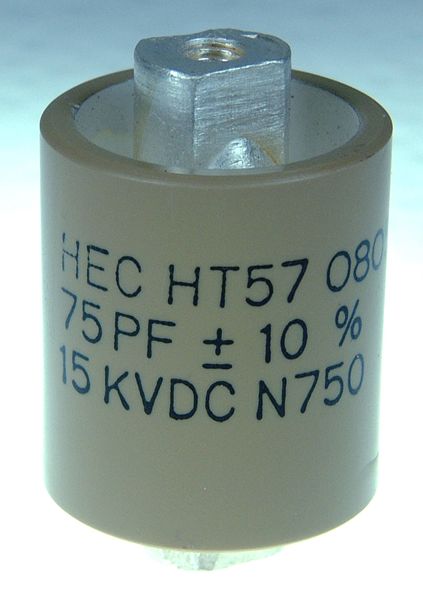
Next we researched some high voltage components for use in building the high power version of the circuit, including this giant capacitor:

Overall our project has been a success. While some of our circuits didn't work out, most of them worked quite well. Our final design works especially well, managing 8 volts out with only 2 volts in.

Monday, 2 March 2015

Week 4(27/2/2015) High-pass network with two levels of discharge models

We started our 4th week design and build the circuits with the given discharge models , we also substitute for a  higher frequency generator which is up to 15Mhz to test the circuits that we build before.  The result is as same as we did with 1MHZ frequency. Additionally, we calculated the load resistance and then test the circuits with L, pi, LCC and T network. 
Discharge models


In the process of calculating the result, there is one problem, because the limitation of components(the value is too big that we cannot find), we only test the L type of circuit for the level 1 load and L,LCC circuit for the level 2 load.
 In the morning, we got the new generator from the tutor, which maximum frequency is 15Mhz. Then we rebuild the circuits that we tested last before, and used new generator to test the behavior of the circuits with higher frequency.  After testing the circuits we build last week, we started to test the circuits with new model.  In the process of testing, we add the inductor to replace imagine part in the calculation to test the difference when there is no inductor added.
L circuit 
retesting the L circuit before with higher frequency

LCC circuit with level 2 load

testing LCC circuit with level 2 load


Sunday, 22 February 2015

Week 3(20/2/2015): Pi network, LCC network and L network with model load.


This week we tested the circuits with L, pi, and LCC circuits with given load accept the T circuits , all the step was as the same as we did before, but the load was changed to a more complex circuits.

                                                                           the model load
according the calculate result, the total load value approx 1 k ohm, the bandwidth is the same as last week which is one tenth of the chosen centro  frequency. we change the load to 1K ohm and rebuild circuits.

we have two problems, one of them is because we don`t have proper value of the capacitor, so we add different value of capacitors to replace. Another unsolved question is that in the T network, the value of inductance was too big and there is no approx component in lab, so we can not build this circuit.


In the morning,  we wait the tutor come to tell us the load circuits then calculate some  values for capacitors and inductance in circuits.  When got the load circuits, we talk about  how to deal with the imagine part. finally we decided ignore the imagine part because when compared to the real part it influence can be  ignored.

in the afternoon, we build the pi, LCC and L circuits, then test the voltage with the model load.

Displaying L high pass circuit.jpg
L high pass circuit.


Displaying L high pass overview.jpg
L high pass overview.


Displaying L low pass circuit.jpg

L low pass circuit on breadboard

Displaying L low pass overview.jpg
 Testing the L low pass circuit

Displaying Pi high pass circuit.jpg
pi high pas circuits on breadboard

Displaying Pi high pass overview.jpg
Testing pi high pass network .
Displaying Pi low pass circuit.jpg
pi low pass circuit on breadboard

Displaying Pi low pass overview.jpg
testing pi low pass network.

LCC circuit on breadboard 

testing LCC circuit.
.

Wednesday, 18 February 2015

Week 2 (13/2/2015): Pi Networks, T Networks and LCC Networks

We started our second week of the project by designing and testing some Pi networks. Unlike the previous L networks, where the bandwidth is fixed, with Pi networks you can design the circuit to have the bandwidth you want, within reason of course (some choices of bandwidth will result in impossible component values). At first we were a bit stuck about what bandwidth to choose. So we asked our lab supervisor, Dr Bowden, for advice and he suggested we aim for a bandwidth of around one tenth of the chosen centre frequency. So with a centre frequency of 1 MHz, we went for a bandwidth of 100kHz.

We had one other problem too. Our research has turned up formulas we could use to select component values for a low-pass circuits, but we had no information on high-pass circuits. At first we thought we could simply swap the placement of the inductors and capacitors, keeping the values the same, but this didn't work. The frequency response was completely wrong, with weird peaks outside the main pass band, and too much attenuation at 1 MHz.

After thinking about the problem a bit more, we realised that we had to keep the reactance between each node of the circuit the same, but change capacitive reactance to inductive reactance and vise versa, as we swapped capacitors with inductors. This meant working out new capacitor and inductor values to keep the reactance the same. Once this was figured out our circuits worked properly, and we were able to build and test both high pass and low pass circuits.

High-pass Pi network on breadboard

 Testing the high-pass Pi network

 Low-pass Pi network on breadboard

Testing the low-pass Pi network

In the afternoon, we moved on to T and LCC networks. The LCC network is a variation of the T network, but instead of being either high-pass or low-pass like the other circuits, the LCC network is bandpass. We designed the LCC network to have a pass band around 1 MHz, then we built and tested both T and LCC networks.

 T network on breadboard

 Testing the T network

LCC network on breadboard
Testing the LCC network

Sunday, 15 February 2015

Week 1 (6/2/2015): L Networks and Future Plans

This week is the first week of our project. Our aim is to build and test several designs for radio frequency impedance matching circuits, with the ultimate goal of designing a network to supply high power RF energy to a gas discharge for use in plasma experiments. Here's our plan for the next five weeks:

Part 1: Testing simple matching networks

In this part of the project, we'll build and test some simple matching networks using three common topologies, with the aim of finding out which topology will work best for our final design. To make this a fair test, all these matching networks will have the same source and load - the 50 ohm output from the signal generator as the source, and a 100 ohm resistor as the load. They'll be designed around a frequency of 1 MHz, but aiming for as wide a bandwidth as possible, so they should still work reasonably well on other, nearby frequencies.

Hopefully we can complete this section in two weeks:
  • In week 1, we plan to design and test both high-pass and low-pass L networks - the simplest matching network design.
  • During week 2, our aim is to design and test both high-pass and low-pass Pi networks, and band-pass T networks and LCC networks.
 

Part 2: Designing a network for gas discharge experiments

By this point, we'll hopefully have some idea of what type of matching network will work best for our needs. Then we've just got to design a new network that will work with a gas discharge as the load. Of course we won't be using an actual gas discharge in the lab, instead we'll be testing with a model load - a circuit made from capacitors, resistors and inductors which looks like a gas discharge to an electrical signal, but without all the high voltages and toxic ozone.
  • First, we'll design a low power version of our matching network during week 3, then test it and make sure it works okay.
  • Week 4 will be spent doing some research and coming up with a theoretical design for a high power network. This should work the same as the low power version, so we just need to find some parts that won't explode or catch fire if you try to send hundreds of watts through them!
  • Finally, in week 5 we'll make sure everything is documented properly and get our presentations ready.
 

So on with week 1...

Week 1 started off with a bit of a problem - we couldn't find our components! Fortunately, it didn't take us long to realise what had happened - somehow they'd ended up in the fourth floor labs instead of on the third floor. That could have been a lot worse...

With that out the way, we got to work on designing some L networks. Our internet research had revealed some helpful formulas so choosing component values was easy. We also made a spreadsheet to calculate component values. When we found both results matched, we knew we were on the right track.

In the morning, we designed a high-pass L network. There was just one problem - the ideal component values our formulas told us we needed didn't quite match up with the real component values that we could buy. This meant we had to make a compromise by choosing the next nearest values. To investigate the effects of this compromise, we decided to build three high-pass L networks - one with the closest possible component values, on with the next highest values, and one with the next lowest values.

High-pass L network on breadboard
 
 Testing the high-pass L network
 
 Testing the high frequency response, with the signal generator set to 2.4 MHz
 
 Resulting output signal on the oscilloscope, allowing us to read the peak voltage
 
In the afternoon, we designed and tested a low-pass version of the L network. Again, we tested three different selections of component values.

Low-pass L network on breadboard
 
 Testing the low-pass L network